Even though this Unit was about muscle, we didn't really hit on the disease aspect of it. Since my sister has muscular sclerosis, I was hoping to learn a little bit more about that. Butt, throughout this unit, I learned a lot of others things. It was a lot of information to take in, but it was interesting.
Sunday, March 27, 2016
Muscular System Reflection Unit 7
Even though this Unit was about muscle, we didn't really hit on the disease aspect of it. Since my sister has muscular sclerosis, I was hoping to learn a little bit more about that. Butt, throughout this unit, I learned a lot of others things. It was a lot of information to take in, but it was interesting.
Wednesday, March 23, 2016
Performance Enhancers and Creatine Satirical Ad
In the Performance Enhancement notes, we learned about different types of stimulants that can help people preform better and more efficiently. People take these performance enhancers for many reasons, be it to aid in athletic ability, build muscle quicker, lose body fat faster, or even to help them recover faster. However, many of them can cause more damage than good. In both females and males, it can cause liver damage, high blood pressure, increased risk of tendon and ligament damage, and heart disease.
In males, it can cause the estrogen to come more into play. For example, testicles can shrink and their breasts can grow. In females, the opposite can occur. Testosterone levels will go up causing male-type facial and hair growth, deepening of the voice, and breast shrinkage.

There are many types of these stimulants that are well known such as caffeine, massages, and carbo-loading. These are the last risky stimulants. People (me included!) drink coffee every morning to get them to wake up, and this causes them to also be more alert and ready.
Other stimulants such as Erythropoietin(can cause stroke or heart attack), Anabolic steroids (can cause high blood pressure and liver damage), and Creatine (side affects listed in the above picture), are a lot more dangerous to use.
Thursday, March 17, 2016
Chicken Dissection Lab Analysis
In this lab, we used whole chickens from Safeway. We were instructed to find many different muscles by cutting into the back, front, wings and legs. In the first incision we cut along the midline of the chest to expose the pectoralis major and the pectoralis minor. These muscles help the bird move its wings, while in humans it pulls the shoulders forwards and down. These two muscles have striations running in opposite ways.After this, we flipped the bird carcass onto its chest and did the same cut on the midline of the back. We peeled back the skin to expose the Trapezius and Latissimus Dorsi muscles. In humans, the trapezius either shrugs the shoulders, or pulls the shoulders back. The Latissimus Dorsi helps to extend the arm or wing.

We extended the wing of the bird next to get a better angle at the Deltoid, Biceps Brachii, and Triceps Humeralis. The Deltoid is located at the top of the shoulder to help with raising your arms. The Biceps Brachii flexes, or bends, the arm, while the Triceps Humeralis extends the arms. The second half of the wing, also our forearm, contained the Flexor Carpi Ulnaris, which flexes the hand, and the Brachioradialis, which pulls the hand back.
Moving onto the Chicken's legs, we found the Sartorius, Iliotibialis, Biceps Femoris, Semimembranosus, and Semitendinosus on the thigh area. The Sartorius flexes the thigh and is what allows humans to cross their legs, the Iliotibialis extends the thigh as well as flexes the knee. The Biceps Femoris flexes the leg, similarly to what the Biceps Brachii does in the arm. The Semimembranosus and Semitendinosus both help with extending the thigh.
![]() |
The last section that we cut into was the drumstick, or the calf of humans. In this area, we found the Gastrocnemius, the Peroneus Longus, and the Tibialis Anterior. The Gastrocnemius extends the foot and flexes the lower leg, the Peroneus Longus also extends the foot, and the Tibialis Anterior flexes the foot.
After we did all of this, we started the cleanup process and disinfected the table, tools and our hands and forearms
Monday, March 14, 2016
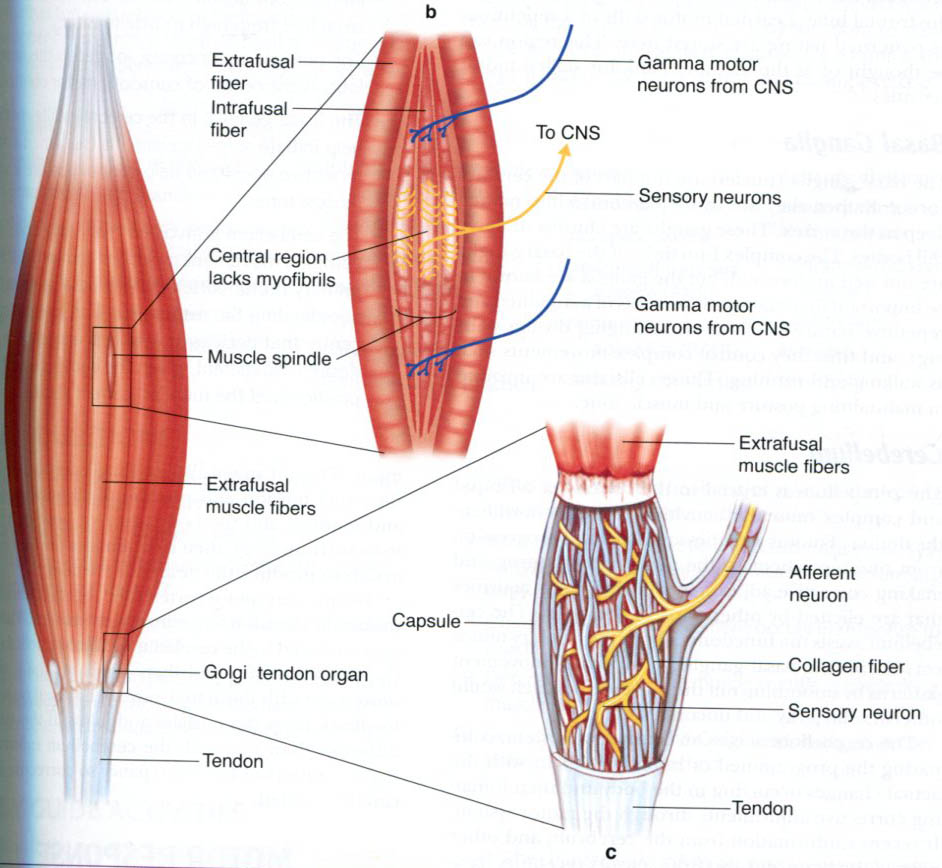
What Happens When You Stretch
--I thought this quote was interesting because it says that the signals are sent to the spine. I'm not really sure why it is sent there. One of the reasons why we hold a stretch for a long time is because we need the muscle spindle to become accustomed to the new length so it stops sending signals.
"The static component of the stretch reflex persists as long as the muscle is being stretched. The dynamic component of the stretch reflex (which can be very powerful) lasts only for a moment and is in response to the initial sudden increase in muscle length."
-The static component is also known as the nuclear chain fibers, and the nuclear bad fibers are responsible for the dynamic component. Both of these are the two kinds of intrafusal muscle fibers.
"When muscles contract (possibly due to the stretch reflex), they produce tension at the point where the muscle is connected to the tendon, where the Golgi tendon is located."
- This is when the lengthening reaction occurs if the tension passes a certain point. The Golgi tendon is responsible for recording the tension.
Relate and Review:
Stretching starts when the sarcomere contracts which causes the areas between the thick and thin myofilaments to increase. When it stretches, the area decreases , and then the muscle fiber become longer. When you stretch the sarcomeres to their capacity, the connective tissue will then be able to stretch just a little bit further.
Tuesday, March 1, 2016
Unit 6 Reflection
In this unit, although we have not done any blogging, we have learned a lot about the skeletal system. The skeleton is used for many different purposes. First, it supports the body. It also protects the bodies soft organs. The skeletal system not only includes 206 bones (luckily we only had to know and remember where 40 of them were), but it also includes cartilage, joints, ligaments(connects bone to bone), and tendons (connects bone to muscle).
There are many different types of bones: long, short, flat and irregular. Long bones tend to be longer than they are wide and contain mostly compact bone. Short bones are typically cube-shaped such as carpals and tarsals. Flat bones are thin, flattened, and usually curved. Some examples of this are the sternum, skull, and ribs. The last type of bone is the irregular bone which does not fit into any other classification. This includes the vertebrae and hips bones.
We also learned about 6 different diseases related to the skeletal system. Arthritis is a common disease where there are over 100 types. This is a disease where there is inflammation in the joints. Osteoporosis is when the bones have lost important minerals such as calcium, and then become brittle and porous. When bones are Vitamin D deficient, it cause softening and weakening of the bones, called Rickets. Scoliosis, Lordosis, and Kyphosis all have to do with the spine. Scoliosis is another commonly known disease that causes abnormal curvature of the spine side-to-side. When there is excessive curvature of the thoracic, or upper region of the spine, it is known as Kyphosis. Similarly, if there is excessive curvature of the Lumbar vertebrae, or lower region of the spine, it is known as Lordosis.
I mentioned before that calcium was one of the main causes of Osteoporosis. Well, calcium actually aids a lot in health. It is necessary for maintaining pH of blood, heart function, nerve function, and the building and repairing of teeth and bones. It is very important to have healthy levels of calcium in your body, otherwise it gets pulled from our bones.
In bone remodeling, there are 4 major cells that contribute. First, are the osteoprogenitor cells. They are dividing cells that develop into osteoblasts, which are the bone-building cells. Osteoblasts secrete collagen and osteocalcin. They then go on to become mature bone cells, or Osteocytes, which carry out the daily activities of bone tissue. Finally, there are Osteoclasts, which are found on the surface of the bones and are responsible for the breaking down of bone tissue.
Another topic that we were taught was on bone fractures. We learned the difference between complete fractures (bone breaks completely through), incomplete or greenstick fracture (fracture does not extend through the bone), and closed or simple fracture (bone does not tear through the skin). It can get more complicated than this when it comes to factures, but I will leave it at this!
I hope you enjoyed reading about my experience of learning about the human skeleton as much as I enjoyed learning about it! Thank You!
Subscribe to:
Posts (Atom)