Wednesday, February 24, 2016

Owl Pellet Lab


Owl Pellet
Skull Top View
 In this lab, we were given an owl pellet to dissect. An owl pellet is something that an owl, usually a barn owl, regurgitates because they can't digest it properly. They usually regurgitate these pellets 2-3 times a day. The pellets mostly consist of fur and bones, so it does not break down. The possible organisms that you will be able to find are shrews, voles, rats, mice and birds.


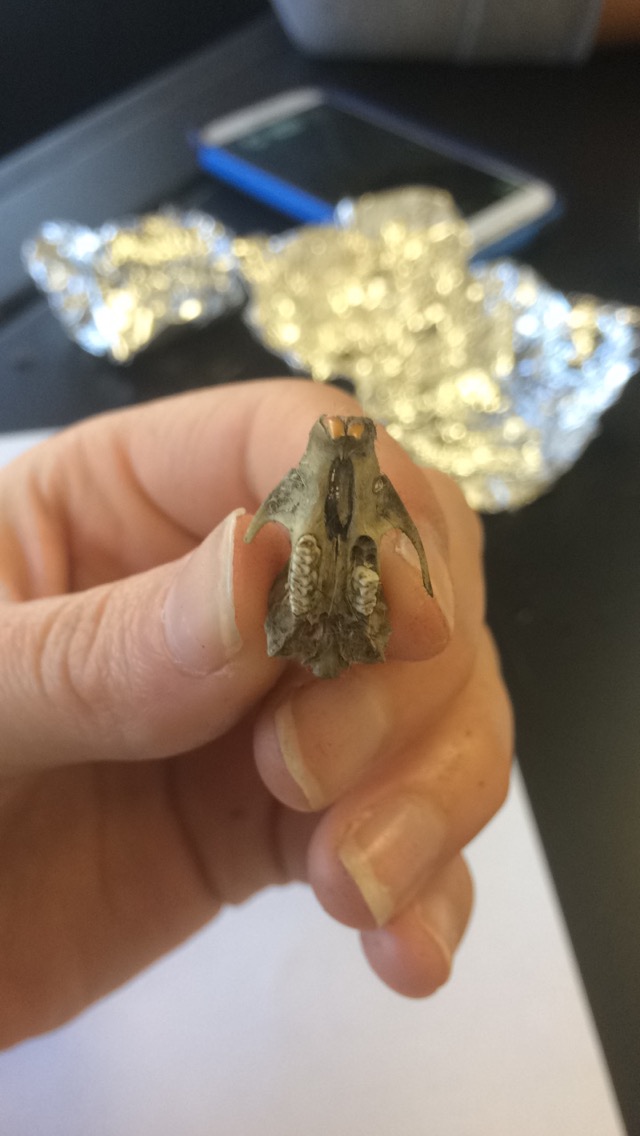
The owl pellet that we dissected ended up having a vole skeleton. Moles and voles are very similar, but we felt that the skeleton was a vole considering the scapula had a more defining corner instead of a curve. Although the pellet was only 4.7 cm long and 2.6 cm wide, we were able to find many bones. The skull and mandible that was produced were shaped like a voles, as well as many of the other bones that we extracted such as the forearm and scapula. It also consisted of many ribs, vertebrae, and tiny bones that were most likely phalanges or carpals. In all, our pellet weighed 6.62 grams.  
Skull Bottom View

As you can see in the picture of the whole skeleton put together, there are many bones that are similar to that of a human. First, the scapula's (aka shoulder blades) look very similar. Also, the vertebrae are categorized by the lumbar, thoracic, and cervical vertebrae. The Lumbar vertebrae are larger than the other two, just like with that of the human vertebrae. You can also see that the vole has a hip socket (black circular hole medial to the spine) where the femur will rotate.

Although, I oriented the bones like that of a human skeleton, the vole's skeleton should be oriented more on its side so that the legs and arms are overlapping. Or course, that would make the skeleton more confusing to look at. In taking a look at the skull of the vole, you can spot another difference. The eye sockets are located on the sides, whereas on a human, they are located in the front.  

This lab was both fun and difficult. It was fun extricating the bones from the pellet, although they were very fragile. It was difficult to piece them together since many of them were broken, as well as discovering what kind of organism it was. The bones were very similar to each other. I enjoyed this lab, and I hope you enjoyed reading about my experience!

Thank You!
Mole Skeleton
Human Skeleton

Thursday, January 28, 2016

Unit 5 Reflection

 "Unit 5 Reflection"


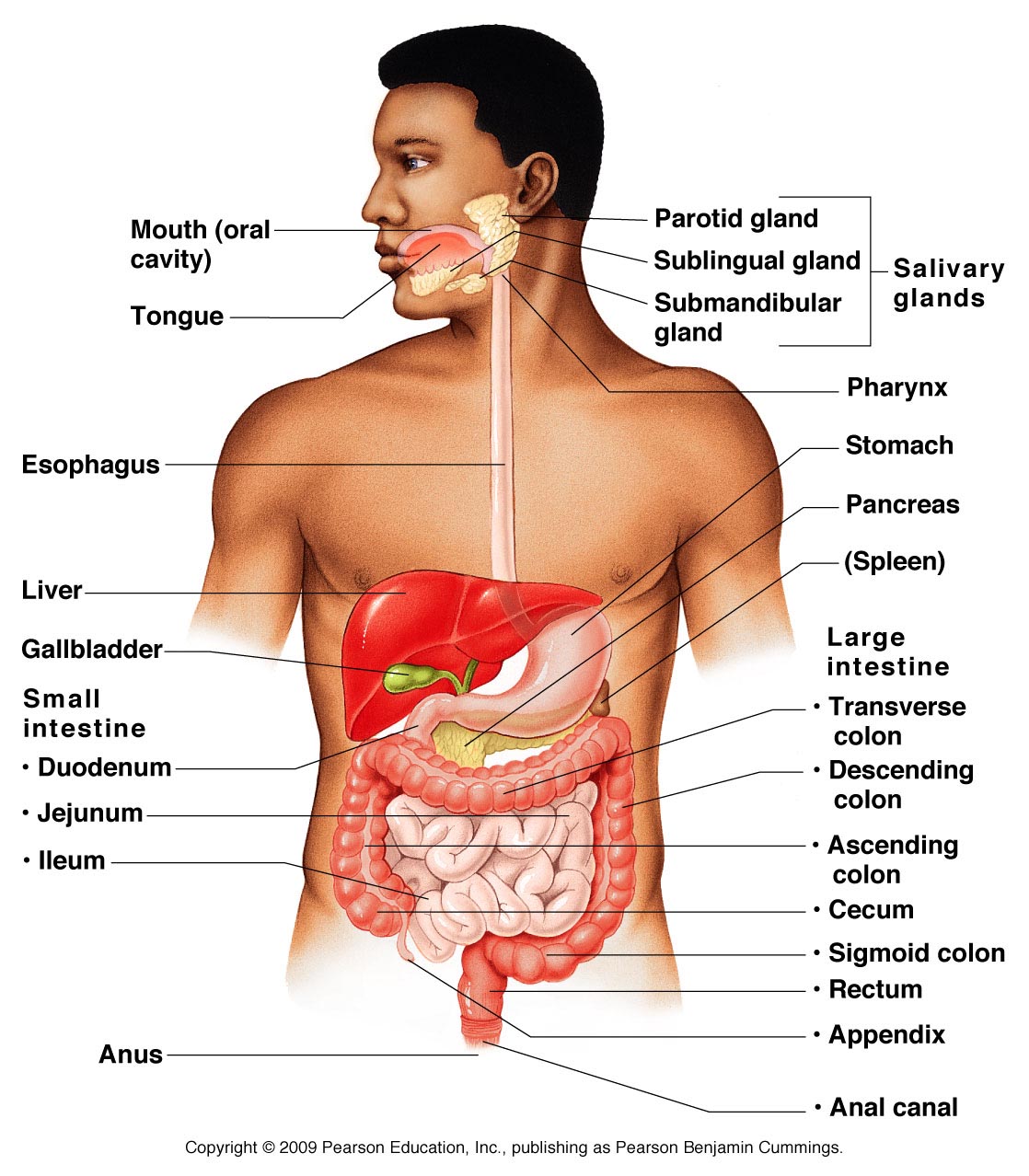
This unit was about the Digestive System, Metabolism, Endocrine System, and Lymphatic System. The Digestive System includes the Alimentary Canal which is the pathway that the food goes from your mouth to being defecated. The picture to the left shows all of the organs in the Digestive/Alimentary Canal. The digestive system is responsible for absorbing, digesting, secreting, and defecating. We did one lab for this unit about the digestive system which I had a previous blogpost as well and that can be found here. In our metabolism there are three stages. Stage 1 breaks down large molecules to smaller ones. Stage 2 takes those small molecules and turns them into Acetyl CoA. Stage 3 has common pathways such as the Krebs cycle and ETC that are oxidation for the fuel molecules. Also, there are three different states.  The Fed state is right after you eat. The pancreas releases insulin and the majority of glucose is taken by the liver to be converted into glycogen. The fasting state is where the insulin levels drop and the glucagon levels rise. The body also uses more fats for energy in order to conserve the glucose. The last state is the Starvation state. This occurs 4-5 days after eating where the muscles rely on adipose tissues for fuel. The Endocrine System controls the processes involved in movement and physiological equilibrium. There are many different glands such as the pituitary gland, the thyroid gland, and the parathyroid gland that are involved in this system. Some organs that are in the endocrine system are the pancreas, which secretes insulin or glucagon; gonads, which are either testes or ovaries that deal with testosterone or estrogen; and the kidneys, which regulate red blood cell production. The last system that we learned about in this unit was the Lymphatic System which specializes in immunity, lipid absorption, and fluid recovery. There are three different kinds of lymphocytes. T-cells, which you ca read more about here from my previous posts, deal with cellular immunity. Then there are b-cells for humoral immunity, and Natural Killer cells which provides immunological surveillance.

I think that this unit was very fascinating but it was a little bit difficult for me to keep up with all the new information. I really enjoy human anatomy and learning about the body, but when there is so much information to learn in a relatively short amount of time, it can be slightly daunting.


Thank you for reading! I hope you enjoyed it!

Amanda

Wednesday, January 6, 2016

Digestive System Lab


Digestive Organ
Length (cm)
Mouth
9.7 cm
Esophagus
42 cm
Stomach
19 cm
Small Intestine
721.36 cm
Large Intestine
180.34 cm
TOTAL
972.4 cm


For this activity, we measured the approximate lengths of each of the organs in our digestive system. For the mouth, we measured from our jaw to the front of our mouth. the esophagus was measured by going from our jaw to the end of our rib cage. The stomach was approximated by taking the length of the space between the thumb and pinky when the hand was stretched out. For the small intestine, we had to convert our height into centimeters and then multiply by 4. Lastly, the large intestine length was found my just taking our height in centimeters. This was an interesting way to figure out how long each organ was. The total length of my digestive system is almost 5 1/2 times the size of my height. This is a serious difference and it is amazing to think that all it would be able to fit in my body just by wrapping and coiling around. I would guess that, on average, it would take about 18 hours for food to move through my entire digestive system. In looking it up, the actual time is 24-72 hours. This makes sense considering people don't defecate every day, as my prediction would suggest. Some factors that may influence the time that it takes to pass through the whole digestive system are that the stomach needs time to break down the food, the bolus has to wind around 9 meters of organs, and in the process, many nutrients and other things are extracted from it on the way. Many muscles are used in this process to make the food used to its full potential. Digestion is different from absorption because digestion is the process of breaking down the food whereas absorption is taking in or soaking up substances or energy. The stomach and the small intestine are involved in the process of digestion, and the large intestine is involved mainly with the absorption aspect. The small intestine does help with absorption as well as digestion.

Monday, January 4, 2016

New Years Goals

New Years Goals

1) My goal for the school year is to get better grades on tests in this class:

  • study further in advance
  • ask for help from friends 
  • go into tutorial to ask clarifying questions to the teacher

2) I would like to use my time more wisely:

  • getting important things that I need to do before I do things for fun. 
  • I need to have my down time be as a reward for my hard work. 
  • get it done during the school week so that i can have the weekend to be more relaxed to get ready for another school week

3) Eat healthier and workout more often:
  • set aside some time to workout each day 
  • plan out more healthy meals that i will eat during the weekend 

Saturday, December 12, 2015

Monday Wellness Reflection

https://docs.google.com/presentation/d/1UR1vzY_YsY7XpSPpRo1RU1pTqrnbz4WGp6l0rRwUcQs/edit#slide=id.p
    
My group and I chose this topic because we all own dogs and believed that they have a major role in helping people. We wanted to know more about therapy dogs and what they did that made them so special and able to aid people with disabilities and such. I personally love all animals and go to either my cat or my dog when I am having a bad day. They are always happy to cuddle. I also believe that one reason why people love animals is because they don't judge you and they listen to you.

Something that was very  interesting to know was that that they could help with stress, social skills, and know exactly when someone with something like bipolar disorder or seizures might have an episode. Many people with PTSD also own dogs. I didn't understand at first why an animal could help with that but then by researching, I realized that at least with people who have PTSD, they weren't able to focus much on their flashbacks because the animal demanded constant attention. From research, we found out that just by owning a dog, symptoms were reduced by up to 82%. These results are amazing considering it is not medication, but a living thing that can aid in recovery. They help with stress by lowering the blood pressure and cholesterol levels. It was also very cool to research the animal assisted therapy on patients with autism because having the responsibility of holding a leash, or throwing a ball for the animal can propel the child into cognitive function and ability. The child is also able to gain self confidence and self-awareness from being in the presence of an animal. Also, having a dog in the household can reduce related allergies by up to 33%. Pets can boost immune system, confidence levels, and provide companionship to combat loneliness.

This topic is important for health and wellness because it shows that animals aid a lot in overall health benefits by keeping your cholesterol and blood pressure levels down as well as improve cognitive abilities in people with disabilities. Animals, especially dogs, can improve someone's health and well being dramatically just by being in their presence. Reduced amounts of stress can lead to more healthy lifestyle because you can get more work done and your body can be more relaxed.

I would grade our project at an 8 because we put a lot of time and energy into it. It was kind of difficult to find how dogs exactly helped with reducing stress levels other than to just say that being around them was enough. There weren't that many studies done on why that is, but we liked and enjoyed learning about what was discovered about it. I would dock the points because out overall project was a little bit short and we didn't have the best activity to go along with it.    

Sunday, November 15, 2015

Heart Dissection Lab Q's

1)  What is the purpose of the pericardium?
-It protects and stabilizes the heart. It keeps the heart lubricated and also prevents it from getting too big.

2)  Observe the blood vessels connecting to the heart. How do arteries differ from veins in their structure?
-arteries are elastic and thick. The walls of arteries contain smooth muscle fiber that contract and relax.

3)  What function do you think the auricle serves?
-They contain oxygenated (left auricle) and deoxygenated(right auricle) blood that are cycled through to either the left ventricle from the left auricle and the right ventricle from the right auricle.

4)  Observe the external structures of the atria and ventricles. what differences do you observe?
-The ventricles are thicker and more muscular than the atria because they pump more blood, further.

5)  Why is the "anchoring" of he heart valves by the chordae tendineae and the papillary muscle important to heart function?
-It ensures that the valves close properly in order for there to not be any leaks that can be fatal.

6)  What is the function of the semi-lunar valves?
-they make sure that the blood is going in the right direction. They prevent the backflow of blood from the arteries to the ventricles during ventricle diastole. The semi-lunar valve also helps maintain pressure on major arteries.

7)  If valvular heart disease occurs on the right side of the heart, it results in swelling in the feet and ankles. Why might this happen?
-The right side of the heart is responsible for pumping blood to the whole body. If the valve is leaking, then the blood isn't able to reach the feet as much.

8)  If valvular disease occurs on the left side of the heart, what would you expect to see?
-You would expect to see lower oxygen in the blood, creating tiredness.


9)  Describe how the left and right sides of the heart differ from each other.
-the right side of the heart is thicker and more muscular because it pumps blood to the whole body, whereas the left side of the heart is thinner because it pumps up blood through the lungs.